

Guests decide how much fun they’ll have within moments of walking into a party. Before a song plays, before a drink is poured, the room itself sends a signal. That signal comes from coordinated sensory environments that shape how people perceive and emotionally respond to a space. It’s not magic. It’s design. And understanding it gives you a serious edge when planning any celebration, from a backyard birthday to a graduation blowout.
Table of Contents
- Why decorations have the power to set the mood
- Key elements: Color, lighting, and focal points
- How to create a cohesive party atmosphere
- Common pitfalls: What most party planners miss
- Our take: Designing party memories, not just rooms
- Ready to set the perfect party mood? Get started with these decoration picks
- Frequently asked questions
Key Takeaways
| Point | Details |
|---|---|
| Decor sets the vibe | Decorations influence first impressions and steer guest emotions from the moment they enter. |
| Lighting is a powerful tool | Color and warmth of lighting can energize or relax a space instantly. |
| Cohesion matters most | A unified theme, palette, and design flow turn décor from random to impactful. |
| Avoid common mistakes | Skipping flow and overcomplicating design are leading reasons party spaces feel off. |
| Start with the feeling | Plan decorations by imagining how you want guests to feel, then choose colors, lighting, and accents to match. |
Why decorations have the power to set the mood
Let’s begin by uncovering why decorations can make or break a party’s atmosphere.
Most people treat decorations as the last item on the planning checklist. Grab some balloons, hang a banner, call it done. But that approach misses something fundamental: decorations are how your guests feel the party before they experience it. The moment someone walks through the door, their brain is rapidly scanning the space, reading visual cues, and forming an emotional response. That response determines whether they relax and open up or stay guarded and distant.
“A well-designed event space doesn’t just look good. It tells guests how to feel. Color, light, and layout act as silent hosts, welcoming people in and setting expectations for the energy of the room.”
Research into sensory design and attendee perception confirms that the visual theme, color palette, lighting, and focal points of a space all influence how guests emotionally respond. This isn’t about having expensive decorations. It’s about using the right ones strategically.
Here’s what decorations actually do for your guests:
- Set emotional expectations the moment they arrive
- Signal the type of event (relaxed vs. high-energy, playful vs. elegant)
- Reduce social awkwardness by giving people natural talking points
- Create memory anchors around specific visual moments
When you start organizing party supplies with this mindset, everything changes. You’re not just buying stuff. You’re building an experience. And if you want a solid foundation to work from, brushing up on birthday decor basics gives you a practical framework before you start layering in creative choices.
Key elements: Color, lighting, and focal points
Now, let’s break down the core components that make decorations so powerful.
Color
Color is the fastest emotional signal in any room. Studies show people form a response to color within 90 seconds of entering a space, and most of that reaction is subconscious. Red and orange tones create excitement, urgency, and warmth. Blues and greens feel calm, open, and refreshing. Yellow brings energy and playfulness, which is why it works so well for kids’ parties. Purple reads as festive and slightly dramatic, perfect for milestone birthdays.
The key is picking 2 to 3 colors and staying consistent. A party that uses gold and navy across tablecloths, balloons, and banners feels intentional. A party with every color of the rainbow, while cheerful, can feel chaotic and overstimulating.
Lighting
Lighting might be the most underrated tool in party design, and it’s where most hosts leave serious mood potential on the table.
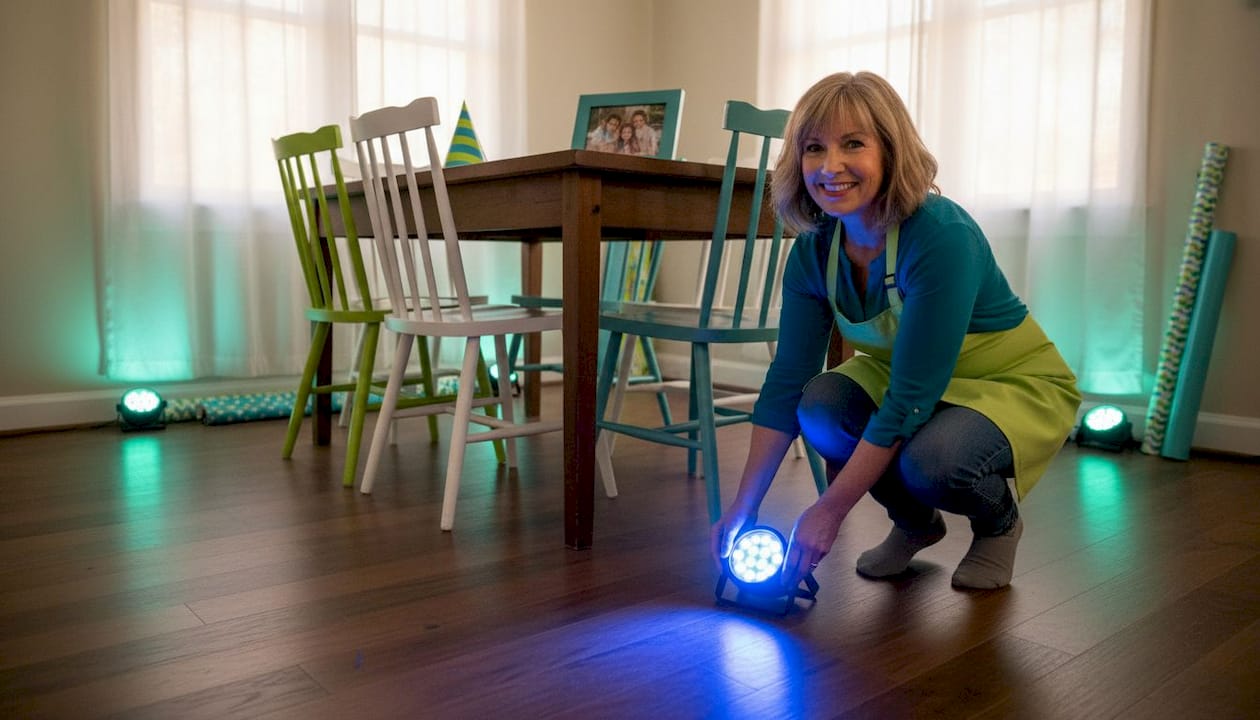
A lab study on lighting color and emotional response using the PAD (Pleasure, Arousal, Dominance) framework found that lighting hue measurably changed perceived affectivity and tranquility. Blue lighting was associated with favorable emotional and thermal impressions. Red lighting showed negative affect and lower tranquility scores. This is why hospital waiting rooms feel so tense under cool fluorescents, and why candlelit dinners feel instantly romantic.
Lighting psychology guidance ties this to practical Kelvin ranges: warm dim lighting between 2200 and 2700K creates coziness and relaxation. Cooler lighting between 4000 and 5000K feels more energized and focused. For most parties, layering both, using warm ambient light overall with cooler task lighting over food stations, gives you the best of both worlds.
Pro Tip: Swap out harsh overhead lighting for string lights, LED uplights, or decorative party candles to transform the room’s feel instantly. The cost is minimal. The impact is huge.
Focal points
Every well-designed party space has at least one focal point. A focal point is a visual anchor that draws the eye, creates a natural gathering spot, and makes the space feel purposeful rather than random.
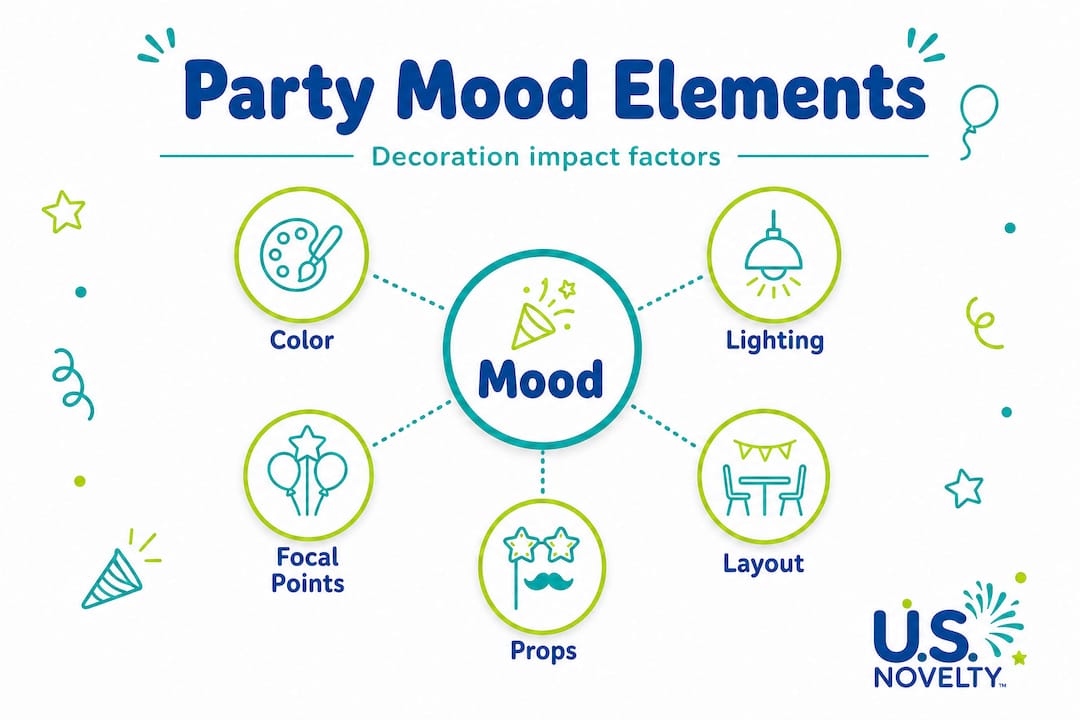
Common focal points include the entrance, the main dessert or food table, a photo backdrop, or a balloon installation. These spots do double duty: they guide guests through the space and create the photo moments people share after the event. Explore creative balloon ideas to see how a simple balloon arch or cluster can become a room’s visual centerpiece without a massive budget.
| Design element | Mood effect | Best use case |
|---|---|---|
| Warm lighting (2200–2700K) | Cozy, relaxed, intimate | Dinner parties, adult celebrations |
| Cool lighting (4000–5000K) | Energized, alert, festive | Kids’ parties, dance-focused events |
| Red and orange color palette | Exciting, warm, stimulating | High-energy parties, sports themes |
| Blue and green color palette | Calm, refreshing, open | Garden parties, spa-themed events |
| Clear focal point | Purposeful, memorable, social | All party types |
How to create a cohesive party atmosphere
With the key elements understood, here’s how to tie them together for a party environment people remember.
The difference between a party that feels thrown together and one that feels designed often comes down to three things: a unified color scheme, intentional lighting, and a clear focal point at the entrance. Evidence from event design research points to these as the pillars that move decorations from “pretty” to genuinely mood-setting.
Here’s a simple step-by-step process to design your party’s atmosphere with purpose:
-
Choose your palette first. Pick 2 to 3 colors that match the event’s emotional tone. A 10-year-old’s birthday might call for bright yellow and turquoise. A 40th milestone birthday might call for black, gold, and deep burgundy. Lock this in before buying a single decoration.
-
Identify your focal points. Decide which areas of the room deserve the most visual attention. Usually this is the entrance, the main table, and a photo spot. Plan your largest decorative investments for these zones.
-
Layer your lighting. Start with warm ambient light for the whole space. Then add accent lighting to highlight your focal points. Candles on the table, string lights over the food station, or a colored LED uplight behind a balloon backdrop all work beautifully.
-
Design the guest journey. Think of arrival, the food and conversation zone, and the active or dance area as three distinct emotional stops. The arrival should feel welcoming and exciting. The food zone should feel relaxed and inviting. The active zone should feel energized.
-
Check for visual consistency. Before guests arrive, walk the room and look for anything that breaks the palette or feels out of place. A stray item in the wrong color can pull the eye away from your focal points and disrupt the flow.
-
Add sensory layers. Music tempo, scent from candles, and even the texture of tablecloths all reinforce the mood your decorations create. Don’t ignore these. They amplify what your eyes see.
Pro Tip: For kids’ party planning, place the most energetic, colorful decorations near the activity area and softer, calmer decor near the food zone. This naturally manages the energy flow without a single instruction to the kids.
The table below shows how to match your design choices to common celebration types:
| Party type | Recommended palette | Lighting style | Key focal point |
|---|---|---|---|
| Kids’ birthday | Bright primaries or theme colors | Bright, warm, playful | Balloon arch at entrance |
| Teen birthday | Neon or monochrome bold | LED color-changing | Photo backdrop |
| Adult milestone | Neutral with metallic accents | Warm and dim | Dessert or champagne table |
| Graduation party | School colors | Bright and warm | Banner and photo display |
| Garden party | Pastels and greens | Fairy lights | Flower centerpieces |
For table centerpiece ideas, think about height variation. Mixing tall and short arrangements on a table creates visual interest and helps the eye move naturally across the space rather than stopping at one level.
Common pitfalls: What most party planners miss
Even the best plans can go awry. Here’s what to watch for so your hard work actually sets the right vibe.
The single biggest mistake is random placement. Buying decorations you love individually, then scattering them around a room without a system, produces visual noise rather than a mood. Guests may notice individual pieces but feel vaguely uncomfortable without knowing why. The Gourmet Host party design approach recommends treating decorations as a system: choose your palette and theme first, then layer lighting and focal points to guide attention from arrival through food zones and on to the active areas. Random placement breaks that choreography entirely.
Here are the most common mistakes and how to avoid them:
- Ignoring lighting. This is the biggest missed opportunity. You can have gorgeous decorations and still have a flat party if the lighting is wrong. Harsh overhead lights kill the atmosphere that soft, warm sources would create. Always assess the room’s existing lighting before you buy a single decoration.
- Clashing themes. Mixing a tropical theme with a superheroes theme because you liked both might seem fun in theory, but it creates visual confusion that makes guests feel subtly unsettled. Commit to one theme and let it guide every choice.
- Over-decorating. More is not always better. A room stuffed with decorations can actually feel overwhelming and claustrophobic. White space (areas without decoration) makes what you do put up stand out more.
- Neglecting the entrance. The arrival experience sets the entire emotional tone. If the entrance is bare or generic, guests’ first impression is neutral at best. A simple balloon cluster, a welcome banner, or a themed arch costs very little but does enormous work.
- Forgetting the practical zones. Food and conversation areas are where guests spend most of their time. Placing all your best decorations at the photo spot while leaving the main seating area bare is a missed opportunity to sustain the mood throughout the event.
Pro Tip: Before your party, take a photo of the room on your phone. You’ll spot imbalances and bare spots you might miss when you’re standing in the middle of it all. A quick snapshot gives you an objective view of the space.
When you’re organizing supplies efficiently in the days before the party, grouping items by zone rather than by type helps enormously. Put all the entrance decorations in one bag, all the table items in another, and so on. Setup becomes faster and the system stays intact.
Our take: Designing party memories, not just rooms
Here’s an opinion that most party planning content skips over entirely: the goal isn’t a beautiful room. The goal is a room that makes people feel something specific at every single moment they’re in it.
Most planning advice focuses on trends, color matching, and what looks good on camera. Those things matter. But they’re secondary to a more fundamental question: how do you want your guests to feel at each moment of the event? The answer to that question should drive every decoration choice you make.
Lighting is where this becomes most concrete. Research confirms that lighting color can shift emotional impressions in controlled experiments, which means “mood lighting” isn’t just a phrase. Fairy lights, uplights, and LEDs are not decorative accessories. They are emotional instruments. Used intentionally, they can shift a room from tense to relaxed, from flat to energized, with almost no budget.
The other thing most planners miss is memory architecture. Certain spots in a party become memory anchors, the moments people will describe when they tell someone about the event. Usually those are the arrival, the cake moment, and a photo spot. If you design those three moments with intention and let everything else support them rather than compete with them, you’ve done the real work of party design.
Browse centerpiece inspiration with this frame in mind. Ask not “does this look nice?” but “does this make my guests feel what I want them to feel?” That shift in thinking is what separates a forgettable party from one people talk about for years.
Ready to set the perfect party mood? Get started with these decoration picks
If you’re feeling inspired to elevate your next event’s atmosphere, here’s where to begin.
At US Novelty, we’ve been helping people create celebration-worthy spaces since 1922. Whether you’re building your first focal point or refining a full party design system, the right supplies make all the difference.
Start with a birthday pennant banner to anchor your entrance with instant visual impact. It’s one of the fastest ways to signal the event’s mood the moment guests arrive. Then explore the full range at US Novelty to find balloons, tableware, themed decorations, and everything else you need to build a cohesive, mood-driven party space. Free shipping on orders over $75 makes stocking up simple.
Frequently asked questions
What color lights make a party feel more relaxed?
Warm dim lighting in the 2200 to 2700K range is best for creating a relaxed and cozy atmosphere, as it signals comfort and intimacy to guests.
How can I make a small party space feel bigger using decorations?
Use lighter colors and strategic lighting to draw the eye toward focal points, since lighting hue measurably changes spatial impression and can make a room feel more open or more enclosed.
Is there proof that party decorations influence guests’ moods?
Yes, studies show that a coordinated sensory environment with purposeful colors, lighting, and focal points measurably changes how guests feel and behave in a space.
What’s a quick way to pick a party theme that works?
Start with a simple 2 to 3 color palette, then build all your decorations and lighting choices around it, since a cohesive design approach turns individual decorations into a unified mood-setting experience.